Engraved Skulls Illustrations: 16 Vintage Vectors for Impactful Design
The Raw Power of Hand-Drawn Anatomy
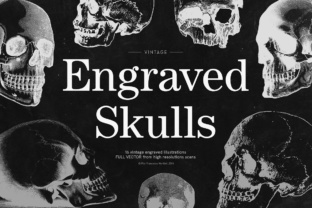
There is a specific kind of graphic weight that modern digital vectors often miss. When we talk about Engraved Skulls Illustrations, we aren't referring to standard clipart or smooth, generic 3D renders. We are talking about the grit and discipline of line work derived from traditional printmaking. This collection contains 16 distinct vintage skull illustrations, born from high-resolution scans of actual etchings. Because these were vectorized from scanned source material, they retain the organic imperfections—the slight variations in line weight and the natural texture—that make vintage art so compelling. For designers working on projects that demand authenticity, these assets offer a bridge between historical accuracy and modern scalability.
The visual personality of these illustrations is undeniably "Memento Mori." They carry a sense of history, mortality, and timelessness. Unlike a modern sans serif font which prioritizes clean geometry, these engravings thrive on detail. You will notice the hatching and cross-hatching techniques used to create depth and shadow. This isn't just a picture of a skull; it is a study in anatomy rendered through the lens of 19th-century craftsmanship. The appeal lies in this duality: it is macabre yet scientific, dark yet intricate.
Practical Applications for Modern Creators
You might be wondering how vintage anatomical art fits into a contemporary workflow. The versatility of these Engraved Skulls Illustrations is surprisingly broad, extending far beyond Halloween flyers. In brand identity, particularly for craft breweries, tattoo parlors, motorcycle clubs, or edgy streetwear brands, these vectors serve as powerful logos or secondary marks. They suggest a brand that is bold, established, and unafraid of strong imagery.
For editorial design and publishing, these assets are invaluable. If you are designing a book cover for a mystery novel, a medical thriller, or a poetry anthology, a high-quality engraving adds immediate gravitas. It signals to the reader that the content is serious or stylized. Similarly, in packaging design, particularly for the spirits industry or artisanal goods, a detailed skull illustration can replace a generic crest, giving the product a "heritage" feel that suggests quality and tradition.
- Apparel and Merchandise: High-contrast engraving styles translate exceptionally well to screen printing on t-shirts, hoodies, and tote bags.
- Web Design and Social Media: Use these as hero images or background textures. Because they are vectors, they remain crisp on high-resolution Retina displays and 4K monitors without bloating load times like heavy JPEGs.
- Stationery and Invitations: Perfect for event invitations (think: "Día de los Muertos" parties or themed galas) and business cards for alternative lifestyle professionals.
Mastering Visual Hierarchy and Readability
Integrating an illustration this detailed requires a strategic approach to visual hierarchy. A common mistake is pairing intricate art with overly complex typography. If you place a highly detailed skull next to a busy script font or a decorative handwritten font, the result is visual noise. The eye doesn't know where to land.
To create a professional layout, contrast is your best friend. The complexity of the Engraved Skulls Illustrations demands simplicity in typography. A bold, geometric sans serif font often works best for headlines, allowing the illustration to act as the primary texture. Alternatively, if you are aiming for a vintage editorial look, pairing the skull with a sturdy, high-contrast serif font can create a cohesive "old-world" aesthetic reminiscent of Victorian medical journals.
Consider the negative space around the skull. Because these vectors are high-resolution scans, they contain a lot of information. In logo design, you may need to simplify the image or isolate a specific part of the jaw or cranium to ensure it reads well at small sizes. This is a crucial step for maintaining professionalism in your final output.
Technical Workflow and Asset Management
Since these assets originated as scanned pictures and were subsequently vectorized, they behave differently than drawings created purely in Adobe Illustrator using the pen tool. You may encounter a higher node count, which is typical for premium font or vector assets derived from raster data.
Practical Tip: Before you begin your project, open the vector file and run a path simplification command if you plan to animate the logo or use it on low-power devices. However, for print projects—such as large format posters or intricate packaging design—keep the high-resolution data intact. The "noise" in the lines is what gives the art its authentic, ink-on-paper feel.
Elevating Your Creative Projects
Using Engraved Skulls Illustrations is about more than just adding a "cool image" to your layout. It is about utilizing design assets that carry historical weight. In a digital landscape saturated with flat, minimal design, the texture and depth of vintage engraving offer a refreshing tactile quality.
For content creators and marketers, these illustrations can stop the scroll. On social media, where feeds are often cluttered with smooth gradients and clean lines, a stark, high-contrast engraving creates a pattern interrupt. It commands attention without needing neon colors or clickbait text.
Finally, remember that consistency builds brand recognition. If you choose to incorporate this style into your brand identity, commit to it. Use the hatching and line-weight characteristics of the skull to inform other design elements. Perhaps your dividers use the same line weight, or your icons mimic the engraving style. This level of detail transforms a collection of random files into a cohesive, professional modern typography